

Mastering Your Internal “Brake Pedal”: 5 Exercises to Tone Your Vagus Nerve
Toning the vagus nerve helps shift the body out of constant fight-or-flight and into a state where it can rest, digest, and recover more efficiently. Simple, science-backed practices like controlled breathing, gentle eye movements, cold exposure, and vocal vibration can improve vagal tone, reduce inflammation, and support heart rate variability when done consistently. These techniques work best when practiced briefly but regularly, rather than intensely or infrequently. According to Dr. Jeff Matz, DC, MS at Via Nova Health, strengthening the vagus nerve is a practical way to improve resilience, calm the nervous system, and enhance overall mind-body health in daily life. For more information, contact us or request an appointment online.


In our previous discussions about brain fog and the gut-brain axis, we touched on a vital highway of information called the Vagus Nerve. In our fast-paced world, our “fight-or-flight” system (the sympathetic nervous system) is often stuck in the “on” position. The Vagus Nerve is your biological “brake pedal”—it is the primary driver of your parasympathetic nervous system, responsible for telling your body it is safe to rest, digest, and heal.
When your vagal tone is optimal, you recover from stress faster, your digestion is more efficient, and your heart rate variability (HRV) improves. When it is sub-prime, you may experience chronic anxiety, poor sleep, and systemic inflammation.
Here are the top five science-backed exercises to stimulate and “tone” your vagus nerve.
The “Basic Exercise” (Eye Movements)
Developed by craniosacral therapist Stanley Rosenberg, this exercise is designed to realign the top two vertebrae (C1 and C2) and increase blood flow to the brainstem where the vagus nerve originates.
- How to do it: Lie flat on your back and interlace your fingers behind your head. Keeping your head perfectly still, move just your eyes to the far right. Hold this position until you feel a spontaneous yawn, sigh, or swallow (this is a sign your nervous system has shifted). Repeat on the left side.
- Why it works: It relaxes the suboccipital muscles, which have a high density of nerve receptors that communicate directly with the vagal complex.
2. Resonance Frequency Breathing (4-6 Breathing)
While all deep breathing is good, “Resonance Frequency” breathing is the specific rhythm that maximizes vagal stimulation.
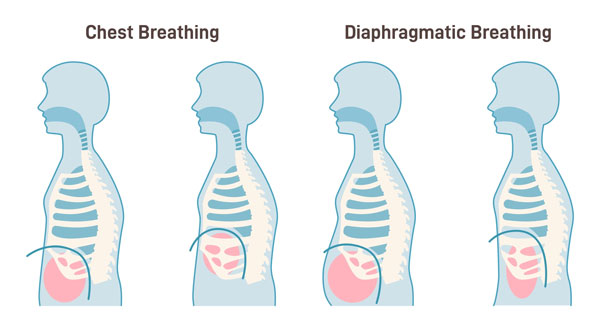
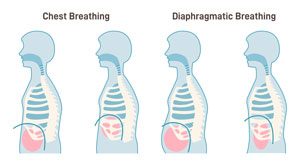
- How to do it: Inhale through your nose for a count of 4. Exhale slowly through pursed lips (like you’re blowing through a straw) for a count of 6. The key is to ensure your belly expands on the inhale, not your chest.
- Why it works: Slowing the exhale to be longer than the inhale stimulates the stretch receptors in the lungs, which sends an immediate “all-clear” signal to the brain via the vagus nerve.
3. Auricular (Ear) Stimulation
The ear is the only place on the surface of the human body where the vagus nerve sends a dedicated branch (the auricular branch).
- How to do it: Using your index finger, find the “cymba conchae”—the small, hollowed-out dip just above the opening of your ear canal. Gently massage this area in small circles or apply light pressure for 1–2 minutes.
- Why it works: Because this skin is directly innervated by the vagus nerve, physical stimulation acts as a “manual override” to trigger a relaxation response.
4. Cold Water Immersion (The “Diving Reflex”)
Sudden cold exposure is one of the fastest ways to trigger the “Mammalian Dive Reflex,” which is mediated by the vagus nerve.
- How to do it: You don’t need a full ice bath. Simply splash ice-cold water on your face for 30 seconds, or hold a cold compress to your neck just below the jawline where the carotid sinus is located.
- Why it works: The sudden temperature drop forces the heart rate to slow down and the vagus nerve to activate to regulate internal homeostasis.
5. Vocal Cord Vibration (Gargling or Humming)
The vagus nerve passes right through the area of your vocal cords and the back of your throat.
- How to do it: Take a deep breath and hum a low-pitched tone for as long as possible, feeling the vibration in your chest and throat. Alternatively, gargle water vigorously for 30–60 seconds.
- Why it works: The physical vibration of the vocal cords mechanically stimulates the vagal fibers, effectively “waking up” the nerve.
Consistency Over Intensity
You don’t need to spend an hour a day on these. The Vagus Nerve responds best to micro-dosing. Choosing just one of these exercises to perform for two minutes every morning or right before a stressful meeting can permanently alter your baseline stress levels.
By toning your vagus nerve, you aren’t just “relaxing”—you are physically upgrading your body’s ability to handle the demands of modern life.
Check Out Our 5 Star Reviews



 Send Text
 How May I Help You?